Glossary
No-Latency & CDN
No-latency live streaming uses RTC for stream pulling on the viewer side, with latency under 400ms on both PC and H5. On unsupported viewers, it degrades to CDN-based stream pulling. Traditional CDN live streaming has higher latency: 3–5s on PC and 10–12s on H5.
Co-hosting & Going on Stage & Going off Stage
Co-hosting: Enables real-time audio/video conversations between the host and viewers, consisting of two processes: going on stage and going off stage. This is achieved via RTC.
Going on stage: A viewer goes on stage and can have real-time audio/video conversations with the host in the same room.
Going off stage: A viewer goes off stage and disconnects from the host, no longer able to have real-time audio/video conversations in the same room.
Session
The same live room can broadcast multiple times. To distinguish different live sessions within the same room, a session ID is generated for each broadcast, used for data statistics and differentiation.
Live Streaming Methods (Video Only)
Normal live streaming: The broadcaster uses POLYV web or client to start streaming, pushes the stream to the server, and viewers pull the stream to watch.
Simulated live streaming: Pre-recorded videos are uploaded to POLYV and then pushed to the server in the form of a POLYV live stream, which viewers pull to watch.
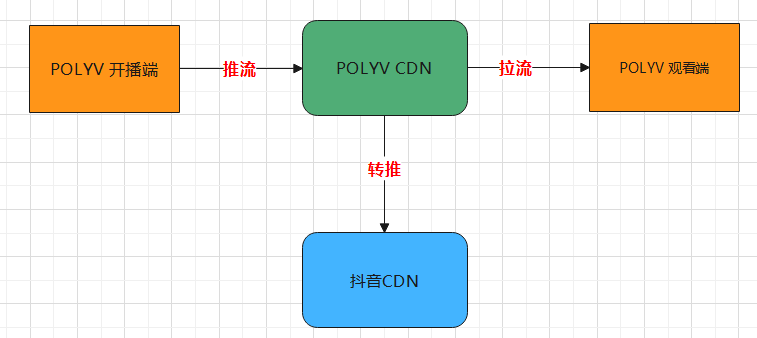
Multi-platform push: POLYV uses its cloud distribution feature to push the live stream to multiple mainstream platforms such as Bilibili, Xiaohongshu, and Douyin.
Pull-stream live streaming: Other mainstream audio/video platforms (e.g., Bilibili, Xiaohongshu, Douyin) provide pull-stream URLs. After configuring them in POLYV's pull-stream live settings, viewers pull the stream to watch.
Relay
Relay: A method of cross-channel live streaming in POLYV. It allows one channel to broadcast while multiple different live rooms can watch. Channels are categorized as relay initiators and relay receivers; by default, a created channel is a relay initiator.
Push & Pull & Re-push
Push: Sends audio/video data captured by a local camera or microphone to the server, e.g., the broadcaster pushes the stream to the CDN.
Pull: Retrieves audio/video data from the server to the local device for viewers to play and watch.
Re-push: Pushes content from the server to other CDN servers.