Introduction
1. Basic Description
Polyv Live Streaming originates from the company's years of video technology accumulation. Based on professional cross-platform video codec technology and large-scale video content distribution networks, it provides stable, smooth, low-latency, and high-concurrency real-time audio and video services.
Polyv Seminar Java SDK allows you to easily access Polyv Live's multi-person meeting scenarios without complex programming.
Polyv Seminar Java SDK is implemented based on the Polyv Seminar API, wrapping and optimizing it. It simplifies common tasks for B-end users. The API call logic and exception handling are encapsulated and optimized. B-end users only need to encapsulate request parameters and hand them over to the Polyv Seminar Java SDK for processing. After processing, the SDK returns results, and the B-end continues its business logic based on the returned data. Currently, the Polyv Seminar Java SDK covers most frequently used API operations, including attendee management, channel information management, and playback information management.
If you encounter any issues while using the Polyv Seminar Java SDK, please contact online customer service to ask post-sales technical support. Please submit the problem's runtime environment, operation steps, error feedback information, and contact details simultaneously to facilitate quick problem identification and resolution.
2. Overall SDK Design
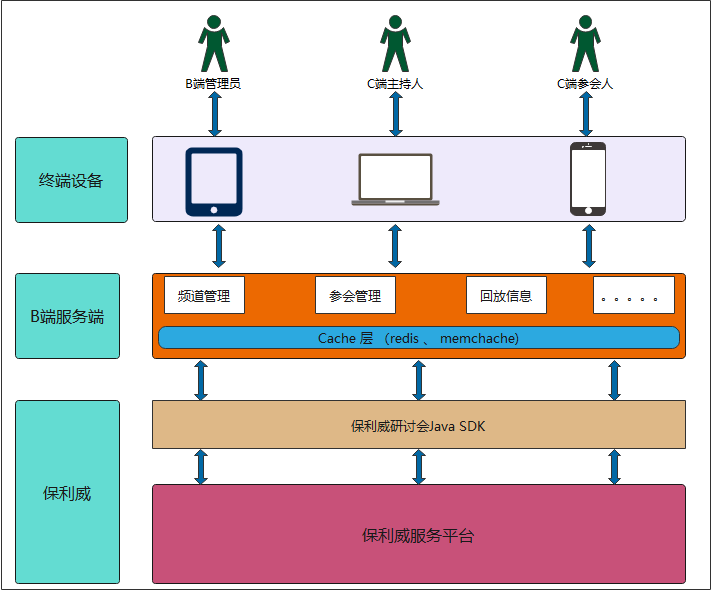
- The B-end administrator creates basic channel information through the SDK, such as channel name, host password, attendee password, and other basic attributes;
- The B-end administrator sets basic channel attendance conditions through the SDK;
- The C-end host logs into the live channel via web pages, live streaming software, or other tools to prepare for the meeting;
- The C-end attendee logs into the live channel via web pages, live streaming software, or other tools to join the meeting;
- After the meeting ends, the B-end performs playback and storage settings, statistical data analysis, and completes the seminar business cycle;

3. Detailed SDK Design
4. SDK Business Logic Analysis
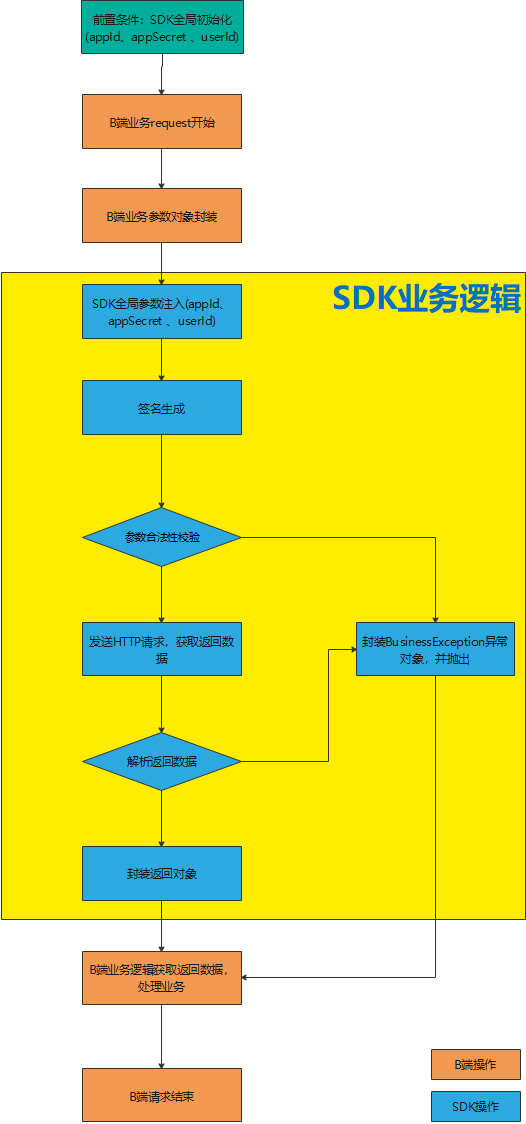
* Prerequisite: SDK global initialization: Before calling the SDK, global parameters must be configured. Configurable parameters include account information (appId, userId, appSecret) and HTTP connection pool parameters (timeout, maxClientNum). For details, see Initialization
* SDK global parameter injection: The SDK injects globally configured parameters into the request object;
* Signature generation: The SDK uses the MD5 algorithm signature rule to generate a signature;
* Parameter validity check: The SDK uses a custom parameter validation tool to check input parameters. If any parameter is invalid, a PloyvSdkException will be thrown. The exception's message includes the specific field that failed validation. This exception is a runtime exception and must be caught and handled in the relevant business logic;
* Send HTTP request and retrieve returned data: The SDK initializes an HTTP connection pool during initialization. All SDK requests are sent through this connection pool;
* Parse returned data: Parse the returned data. If the SDK call is successful, the response object will be encapsulated and returned normally. If the server returns an error message, the SDK will throw a PloyvSdkException. The exception's message includes the specific server execution error information. This exception is a runtime exception and must be caught and handled in the relevant business logic;
5. Call Flow Template
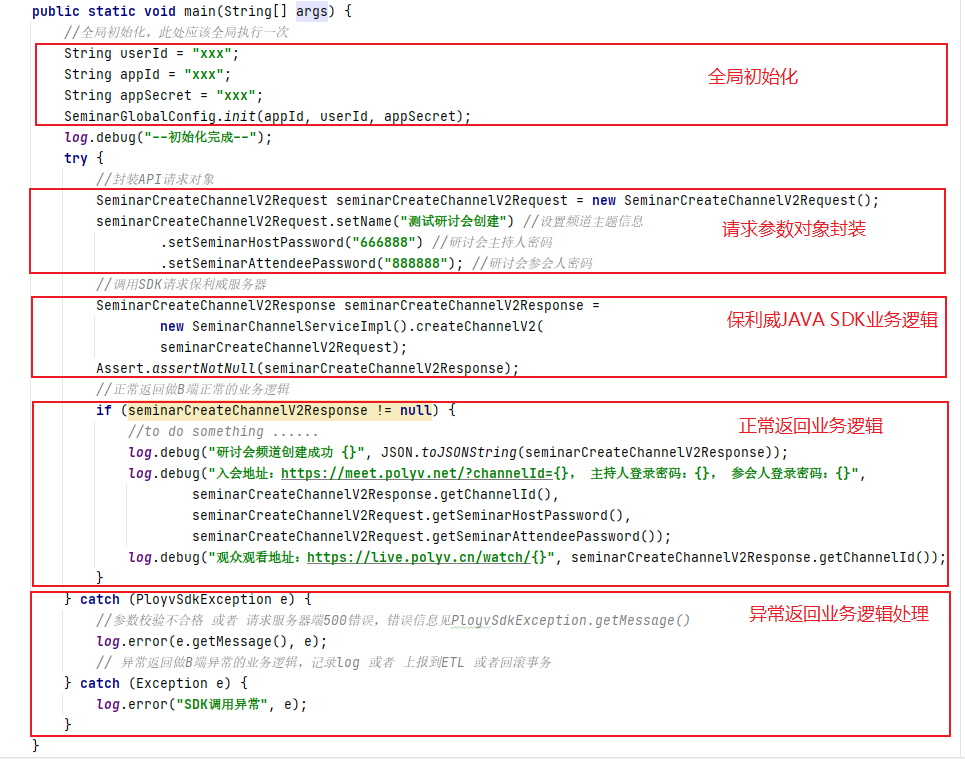
The above business flow diagram is parsed into code as follows. All calls to the Polyv Seminar Java SDK can refer to the following call template (global initialization only needs to be called once globally).